Debunking the Myth: Do ICF Homes Crack?
Debunking the Myth: Do ICF Homes Crack?
Separating Fact from Fiction About Insulated Concrete Form Construction
One of the most common questions homeowners, developers, and builders ask when exploring Insulated Concrete Form (ICF) construction is:
"Do ICF homes crack?"
It's a fair question. After all, concrete is involved, and many people associate concrete with cracks in sidewalks, driveways, and older foundations.
The reality is far different.
At DCL Fortress Superstructures, we frequently hear concerns about cracking. The truth is that properly designed and installed ICF structures are among the strongest, most durable, and most resilient building systems available today.
Let's separate myth from reality.
Understanding Concrete Cracks
First, it's important to understand that not all cracks are the same.
Concrete naturally experiences slight shrinkage as it cures. In some cases, small hairline cracks may develop. These are often cosmetic and do not affect the structural integrity of the building.
The real question isn't:
"Can concrete crack?"
The real question is:
"Will a crack compromise the safety, strength, or performance of the structure?"
In properly engineered ICF construction, the answer is overwhelmingly no.
Why ICF Walls Are Different
Unlike traditional concrete walls, ICF walls are reinforced with steel and protected by continuous insulation on both sides.
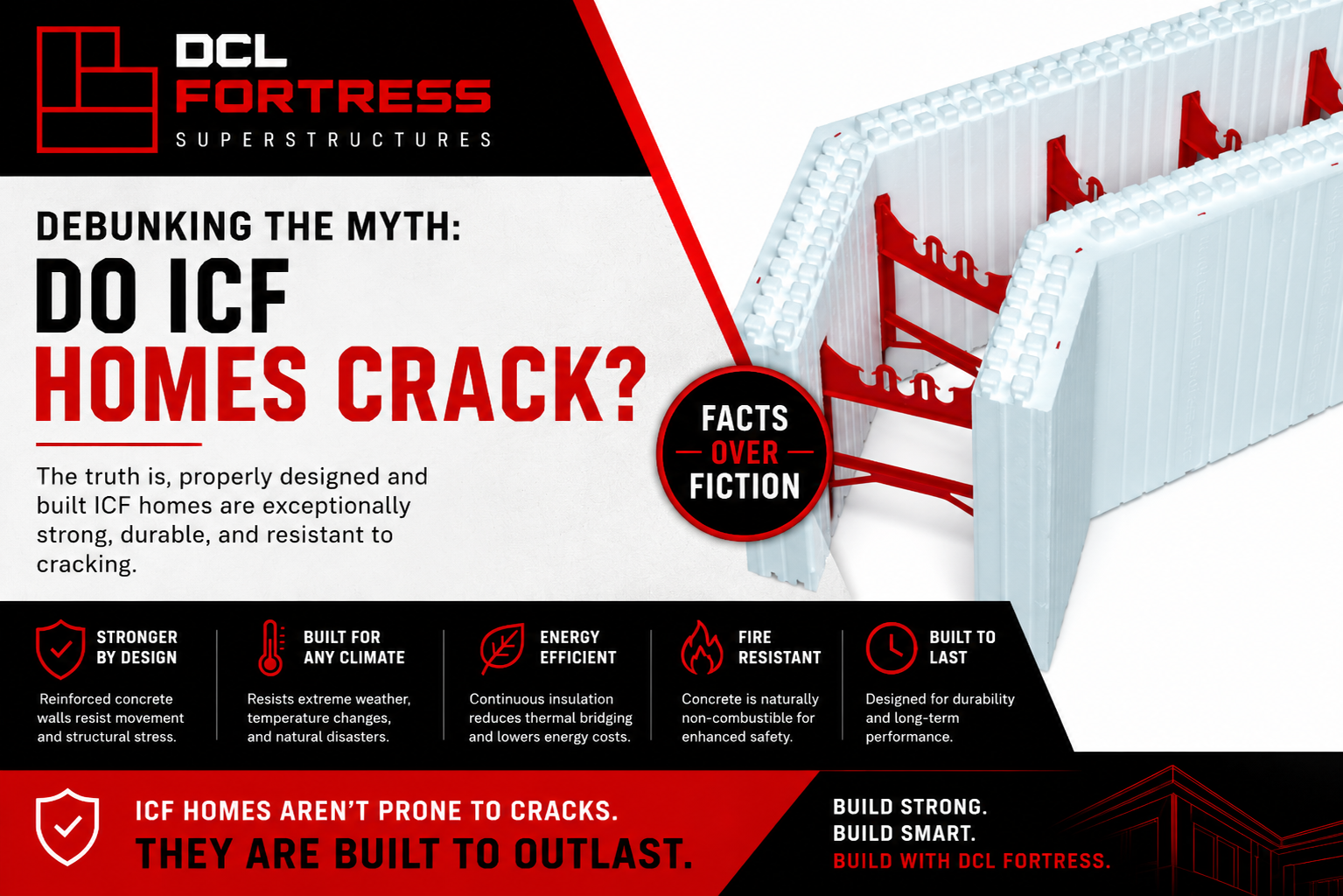
An ICF wall consists of:
- Reinforced concrete core
- Steel reinforcement (rebar)
- High-performance insulated forms
- Continuous structural support
This combination creates a monolithic wall system designed to distribute loads evenly and resist movement more effectively than conventional construction methods.
The result is a structure that is significantly less susceptible to major cracking caused by:
- Settlement
- Temperature fluctuations
- Wind loads
- Seismic activity
- Moisture-related expansion and contraction
Myth #1: "All Concrete Homes Eventually Crack"
Reality:
All building materials experience movement over time.
Wood expands and contracts.
Steel flexes under load.
Drywall develops stress cracks.
Concrete may develop minor shrinkage cracks during curing.
However, the presence of a small crack does not indicate structural failure.
In fact, properly reinforced concrete is specifically engineered to accommodate normal stresses while maintaining structural performance for decades.
ICF construction enhances this performance by incorporating continuous reinforcement and insulation, which help minimize temperature-related movement and stress.
Myth #2: "ICF Homes Crack More Than Traditional Homes"
Reality:
The opposite is often true.
Traditional wood-frame homes can experience:
- Wall shifting
- Nail pops
- Drywall cracking
- Foundation movement
- Moisture-related warping
ICF structures provide a rigid and reinforced building envelope that resists many of the movement issues commonly found in conventional construction.
Because the walls are constructed as a continuous reinforced concrete system, they often experience less structural movement than traditional framing systems.
Myth #3: "A Crack Means the Structure Is Unsafe"
Reality:
Not all cracks are structural.
Many visible cracks found in homes are cosmetic and unrelated to the building's structural integrity.
Engineers evaluate cracks based on factors such as:
- Width
- Length
- Location
- Pattern
- Movement over time
Hairline shrinkage cracks are common in many concrete applications and rarely indicate a structural concern.
Proper engineering, reinforcement, and installation ensure that an ICF structure maintains its strength even under demanding conditions.
Why DCL Fortress Builds with ICF Technology
At DCL Fortress Superstructures, our mission is to create buildings engineered for the realities of today's climate and tomorrow's challenges.
ICF technology delivers:
Superior Structural Strength
Reinforced concrete walls provide exceptional load-bearing capacity and long-term durability.
Disaster Resilience
ICF structures are engineered to withstand:
- Hurricanes
- High winds
- Storm surges
- Flying debris
- Extreme weather conditions
Enhanced Energy Efficiency
Continuous insulation reduces thermal bridging and helps lower heating and cooling costs.
Improved Fire Resistance
Concrete construction provides significantly greater fire resistance compared to traditional wood framing.
Long-Term Performance
ICF structures are designed to maintain their integrity for generations with minimal maintenance requirements.
What Actually Causes Significant Cracking?
When major structural cracks occur in any building system, they are often linked to factors such as:
- Poor soil preparation
- Inadequate engineering
- Improper reinforcement
- Construction errors
- Foundation settlement
- Water management issues
These problems are not unique to ICF construction.
That's why partnering with experienced professionals is critical to ensuring proper design, engineering, and installation from the beginning.
The Bottom Line
The belief that ICF homes are prone to cracking is one of the most persistent myths in modern construction.
While concrete can experience normal shrinkage during curing, properly engineered and installed ICF structures are among the strongest and most durable building systems available today.
In many cases, ICF construction offers greater resistance to movement, environmental stress, and structural deterioration than traditional building methods.
For homeowners and developers seeking long-term performance, energy efficiency, and disaster resilience, ICF remains one of the smartest investments in modern construction.
Build with Confidence. Build with DCL Fortress.
At DCL Fortress Superstructures, we specialize in resilient, high-performance building systems designed to stand the test of time.
Whether you're planning a residential home, commercial project, or climate-resilient development, our team can help you understand how ICF technology delivers strength, efficiency, and peace of mind.
Ready to build stronger, smarter, and safer?
Contact DCL Fortress today to learn more about our advanced ICF construction solutions and discover why the future of building is built on strength.